Relative Clauses : Relative Clauses Games And Activities Edutaining English Learners / There are two types of relative clauses:
Relative Clauses : Relative Clauses Games And Activities Edutaining English Learners / There are two types of relative clauses:. Learn more about these constructions by watching the video! Produce written sentences, using the relative clauses taught. A relative clause is also known as an adjective clause. Relative clauses tell us more about people and things: We use relative clauses to give extra information about something.
We can use relative clauses to combine clauses without repeating information. Relative clauses give us information about the person or thing mentioned. Imagine, tom is in a room with five girls. The choice of a relative pronoun depends a lot on the type of clause. The person who built this must be a great dad.
Relative Clauses Clause Pronoun from imgv2-1-f.scribdassets.com A defining relative clause usually comes immediately after the noun it describes. The woman who lives next door works in a bank. We use 'who' for people and 'which' for things. Sometimes, you may need or want to add additional information to a noun in a sentence for clarity, context, or style. Marie curie is the woman that discovered radium. Relative clauses allow us to provide additional information without having to start a new sentence. Next, it will begin with a relative pronoun (who, whom, whose, that, or which) or a relative adverb (when, where, or why). The choice of a relative pronoun depends a lot on the type of clause.
' = defining relative clause.
Relative clauses are clauses starting with the relative pronouns who*, that, which, whose, where, when. In some of the sentences, you can leave off the relative pronoun. Relative clauses follow the noun they are describing, and are set off from the main clause by commas. They are introduced by a relative pronoun like 'that', 'which', 'who', 'whose', 'where' and 'when'. A relative clause is a subordinate clause that contains an element whose interpretation is provided by an expression on which the subordinate clause is grammatically dependent. We can use 'who', 'which' or 'that'. In the sentence the dragon who breathed blue fire has retired, who breathed blue fire is a relative clause. We use 'who' for people and 'which' for things. Then test your knowledge in the free exercises. The children who play in this treehouse are very lucky. One way to do this is to add an adjective (for example, red ball). These are the flights that have been cancelled. Learn more about these constructions by watching the video!
They include a subject and a verb or verb phrase and are introduced by words known as relative pronouns and relative adverbs. This car belongs to a woman. First, let's consider when the relative pronoun is the subject of a defining relative clause. The person who built this must be a great dad. In some of the sentences, you can leave off the relative pronoun.
Add S Or Es Or Ies All Things Grammar from www.allthingsgrammar.com However, a preposition may also start it off when we need to express our ideas more formally. Relative clauses give us more information about someone or something. The choice of a relative pronoun depends a lot on the type of clause. Relative clauses a relative clause can be used to give additional information about a noun. It is sometimes called an adjective clause because it functions like an adjective—it gives more information about a noun. We can use relative clauses to combine clauses without repeating information. This is the house which jack built. If it was left out, the sentence would still make perfect sense:
In english, there are two types of relative clauses:
Relative clauses follow the noun they are describing, and are set off from the main clause by commas. These are the flights that have been cancelled. Firm up the use of who and that in relative clauses understand and apply the use of where in relative clauses connect words to create a sentence, identifying the subject, the type of relative clause that corresponds to each one and the verb. This car belongs to a woman. There are two kinds of relative clauses: A relative clause is one kind of dependent clause. Imagine, tom is in a room with five girls. Next, it will begin with a relative pronoun (who, whom, whose, that, or which) or a relative adverb (when, where, or why). It is sometimes called an adjective clause because it functions like an adjective—it gives more information about a noun. Relative clauses give us information about the person or thing mentioned. A relative clause is another term for an adjective clause. A relative clause can be restrictive or nonrestrictive (essential or nonessential) restrictive relative clauses restrict or define the meaning of a noun and are not set apart by commas. Learn more about these constructions by watching the video!
The person who built this must be a great dad. They include a subject and a verb or verb phrase and are introduced by words known as relative pronouns and relative adverbs. Finally, it will function as an adjective, answering the questions what kind? We can use 'who', 'which' or 'that'. A relative clause can be introduced by either a relative pronoun or a relative adverb.
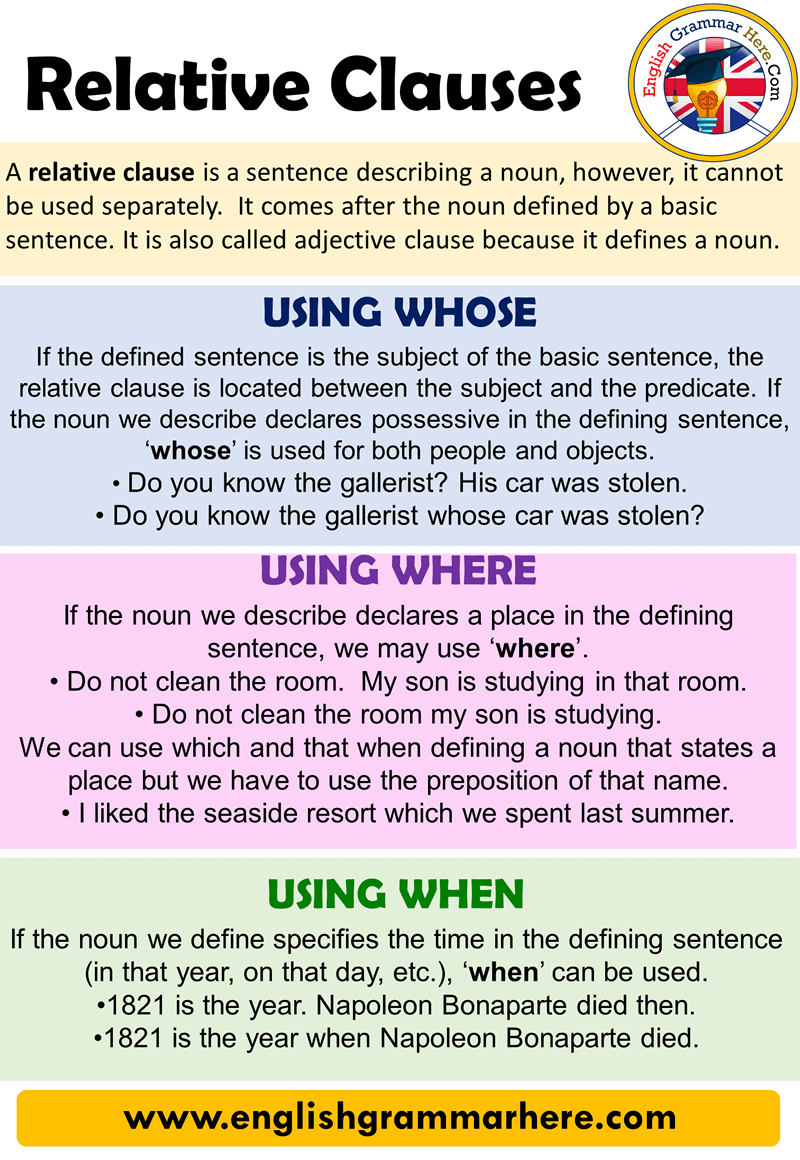
Relative Clauses And Example Sentences Using Whose When Why Where English Grammar Here from englishgrammarhere.com We can get more information into a sentence without the need to start a new one. Relative clauses a relative clause can be used to give additional information about a noun. We use 'who' for people and 'which' for things. In each sentence, include a relative clause. Relative clauses are clauses starting with the relative pronouns who*, that, which, whose, where, when. Learn more about these constructions by watching the video! Firm up the use of who and that in relative clauses understand and apply the use of where in relative clauses connect words to create a sentence, identifying the subject, the type of relative clause that corresponds to each one and the verb. It has a subject and verb, but can't stand alone as a sentence.
Lord thompson, who is 76, has just retired.
First, let's consider when the relative pronoun is the subject of a defining relative clause. Defining relative clauses (also called identifying relative clauses or restrictive relative clauses) give detailed information defining a general term or expression. Produce written sentences, using the relative clauses taught. 'saris which are made of silk are expensive. Lord thompson, who is 76, has just retired. The choice of a relative pronoun depends a lot on the type of clause. A relative clause can be introduced by either a relative pronoun or a relative adverb. A relative pronoun is a word like that or which or who, so a relative clause is a clause that begins with a relative pronoun. We can use 'that' for people or things. A defining relative clause usually comes immediately after the noun it describes. Relative clauses are dependent clauses that cannot stand alone, meaning they are like toddlers who need parental guidance all the time. Relative clauses give us more information about someone or something. We use 'who' for people and 'which' for things.



Komentar
Posting Komentar